Email : info@anwell-hardware.com

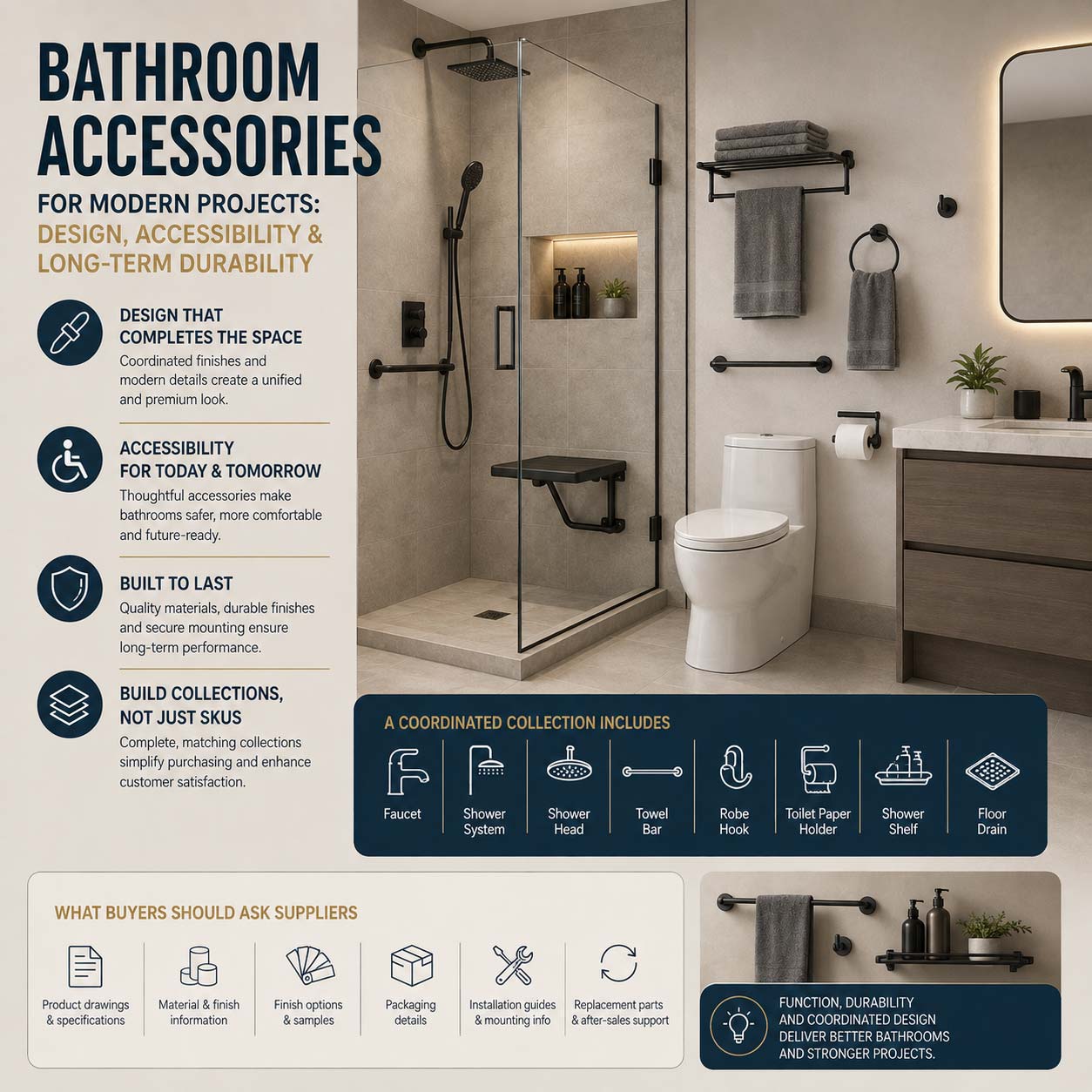

Bathroom accessories are often treated as secondary products, but they have a surprisingly large influence on how a finished bathroom looks and functions. For developers, contractors, retailers and bathroom brands, selecting the right accessories can improve usability while creating a more complete product offering.
Today’s market is moving toward bathrooms that are easier to use, easier to maintain and better prepared for long-term needs.
From Decoration to Everyday Function
Traditional bathroom accessories mainly focused on storage and convenience: towel bars, robe hooks, toilet paper holders and shelves.
Modern designs increasingly combine these functions with visual consistency. Customers expect the accessories to match the finish and style of their faucet, shower system and other fixtures.
For a contemporary project, a coordinated matte black or brushed nickel collection can create a more unified appearance. For hospitality or premium residential projects, brushed brass and other warm metallic finishes can add a stronger design element.
This makes bathroom accessories an important part of product collection planning rather than an afterthought.
Accessibility Is Influencing Product Selection
Accessibility is becoming a mainstream consideration in bathroom remodeling. Houzz’s 2025 U.S. Bathroom Trends Study found that 68% of homeowners considered special needs in their bathroom projects, with many planning for future aging or mobility requirements.
This has practical implications for product sourcing.
Grab bars, shower seats, handheld shower systems, easy-reach controls and low-threshold shower designs can make bathrooms more adaptable without making them look institutional.
In one common application, a residential bathroom may combine a low-curb shower with a handheld shower head, strategically positioned controls and a grab bar. The result can support both everyday convenience and future accessibility.
Durability Should Be Evaluated at the Material Level
For bathroom products, appearance alone does not tell the full story.
A supplier should be able to provide information about base materials, surface treatment and corrosion resistance. This is particularly important for products installed close to water sources.
For bathroom hardware, buyers should also consider mounting strength and the expected load of frequently used items such as towel bars and shelves.
In coastal areas, hotels and other high-humidity environments, surface durability becomes even more important because salt, moisture and frequent cleaning can accelerate deterioration.
Build Collections, Not Individual SKUs
For distributors and online brands, a coordinated product collection can simplify purchasing decisions and improve cross-selling.
A typical collection might combine:
- Faucet
- Shower system
- Shower head
- Towel bar
- Robe hook
- Toilet paper holder
- Shower shelf
- Floor drain
Matching finishes and consistent design details help these products work together visually.
This strategy is particularly useful for e-commerce because customers can purchase a complete bathroom look instead of searching for compatible products from multiple suppliers.
What Buyers Should Ask Suppliers
Before confirming a new product range, buyers should request product drawings, material specifications, finish options, packaging details and samples. For larger projects, installation instructions and replacement-part availability should also be discussed.
A reliable bathroom accessories supplier should understand that product quality includes more than appearance. Consistent dimensions, secure mounting, durable finishes and responsive after-sales support all contribute to the total purchasing experience.
As bathroom design continues to move toward accessibility, wellness and long-term usability, accessories that combine function, durability and coordinated design are likely to become increasingly valuable across residential, hospitality and commercial markets.