Email : info@anwell-hardware.com


Excerpt: Learn how to review packaging for exported bathroom fittings, from protecting finishes and securing accessories to choosing cartons, evaluating transport tests and documenting the approved packing method.
Bathroom hardware packaging affects whether an export order arrives ready for sale or needs sorting, replacement and customer explanations. A faucet may leave production with a clean finish, yet loose fittings or repeated movement inside the carton can damage that finish before installation. For importers, packaging deserves an approval process alongside the product itself.
The objective is practical: protect visible surfaces, keep components together and select a shipping package suited to its distribution route. A courier sample, a master carton and a palletized project order do not necessarily face the same handling conditions.
Approve Bathroom Hardware Packaging From the Inside Out
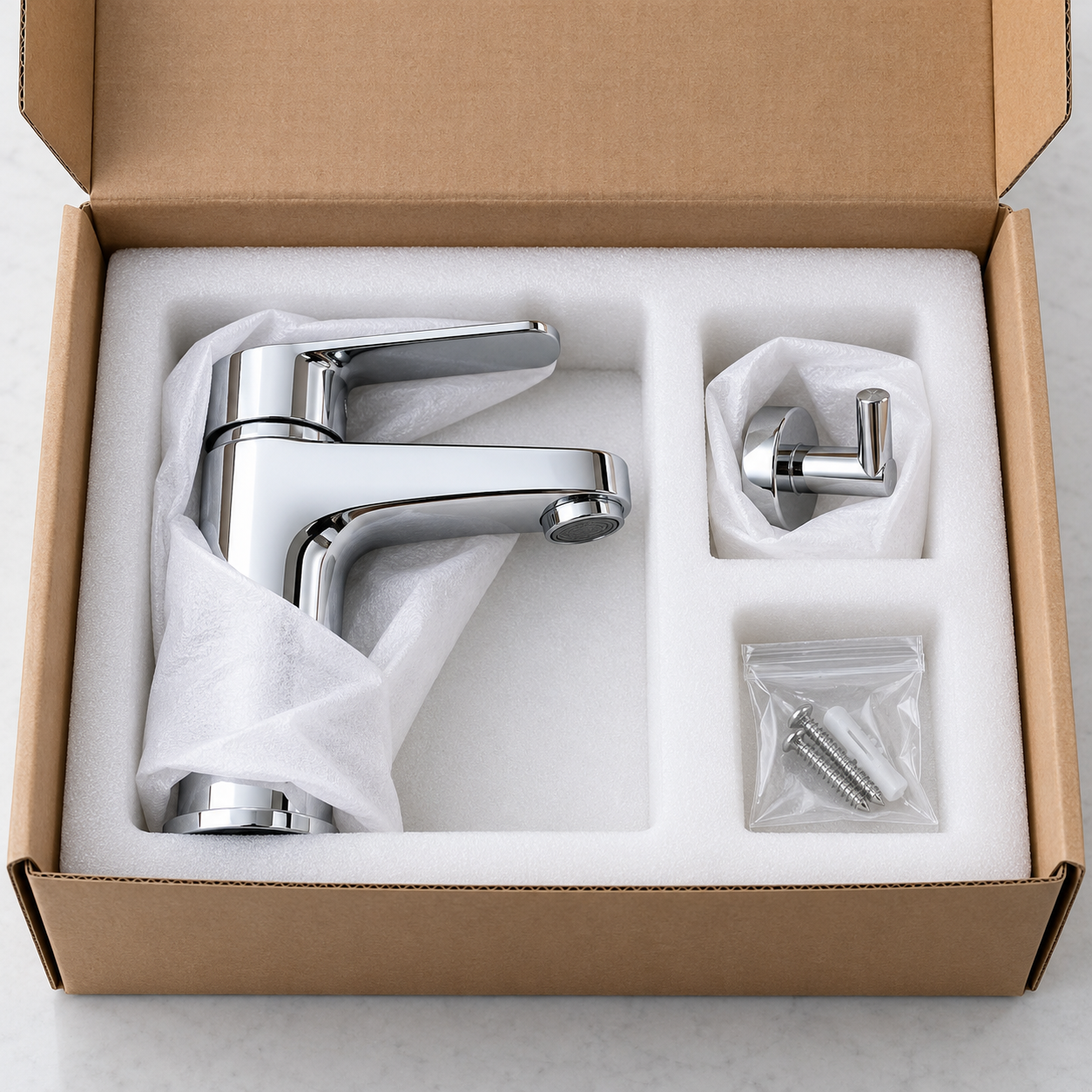
Begin with the surfaces customers will see. Separate chrome, painted and decorative metal parts from screws, brackets and other hard components. Use a clean protective layer suitable for the finish, then support the product so that it cannot rub repeatedly against the carton or adjacent parts.
Ask the supplier to demonstrate unpacking as well as packing. A sleeve that protects a faucet but catches on a projecting handle can be awkward to remove. Adhesive film should be checked for residue and removal behavior on the actual finish, rather than approved from a packaging-material sample alone.
For an accessory set, place each item in a defined compartment. Keep mounting screws and anchors in a sealed bag away from visible metal surfaces, and identify which fittings belong to which product. This helps receiving teams check completeness without emptying every carton onto a bench.
Control Movement Before Adding More Material
Extra cushioning is useful only if it performs a clear task. The insert should support the product, protect vulnerable projections and prevent hard parts from meeting each other. Loose void fill may settle, so the packed arrangement needs review after handling rather than only when first assembled.
FedEx’s guidance for packing breakables emphasizes restricting movement, individually protecting fragile items and choosing a box with room for cushioning. These are useful principles for delicate hardware configurations; the specific cushioning system still needs validation for the product’s weight, geometry and route.
Check what happens when the pack is turned onto another face. A faucet handle, shower arm or mounting stem should not become the main support point. Record the approved insert layout so that repeat orders use the same protective arrangement.
Specify the Carton and the Shipping Unit
Agree on the packed weight, carton dimensions, quantity per master carton, closure method and intended stacking arrangement. Selecting a carton merely because it holds the items leaves important questions unanswered. Its strength must suit the load and handling plan, including the inner packaging.
For palletized orders, review the complete shipping unit. Cartons should be supported by the pallet, and restraint should keep the load stable without crushing the boxes. Edge protection or a different stacking pattern may be necessary for the particular product and load.
DHL’s large-shipment packing guidance highlights weight distribution and pallet stability. Coordinate these details with the freight provider, especially when a shipment will be transferred between transport modes or opened for onward distribution.
Choose Tests That Reflect the Distribution Route
A basic drop check can reveal a weak design, but it does not represent every transport hazard. Ask a packaging laboratory to recommend a procedure based on the actual route, packed weight and shipping unit.
The ISTA test-procedure overview distinguishes early screening tests from general simulations of transport hazards. It also identifies different procedures for parcel delivery, mixed less-than-truckload shipments and unitized full-truckload loads. A report for one shipping configuration should not automatically be accepted as evidence for another.
Test the product and its intended packaging together. Before testing, define acceptable outcomes: finish condition, component completeness, product function and carton integrity. Photograph the samples before and after evaluation, and record the packaging revision tested. If the route introduces moisture or other conditions outside the selected procedure, discuss additional evaluation with the laboratory.
Make the Approved Pack Repeatable
Turn the sample approval into a written packing specification. Include the protective sleeve, insert, accessory bag, unit box, master carton, closure and any pallet requirements. Specify which changes need approval before production packing begins.
For example, replacing a fitted insert with a cheaper loose filler may change how a heavy mixer moves in transit. A revised carton quantity can also alter weight and stacking performance. Treat such changes as packaging revisions and evaluate them before accepting the new arrangement.
Effective bathroom hardware packaging combines surface protection, secure positioning and route-appropriate validation. Share your product list, shipment format and destination with Anwell Hardware when discussing the packing requirements for your next sourcing enquiry.