Email : info@anwell-hardware.com

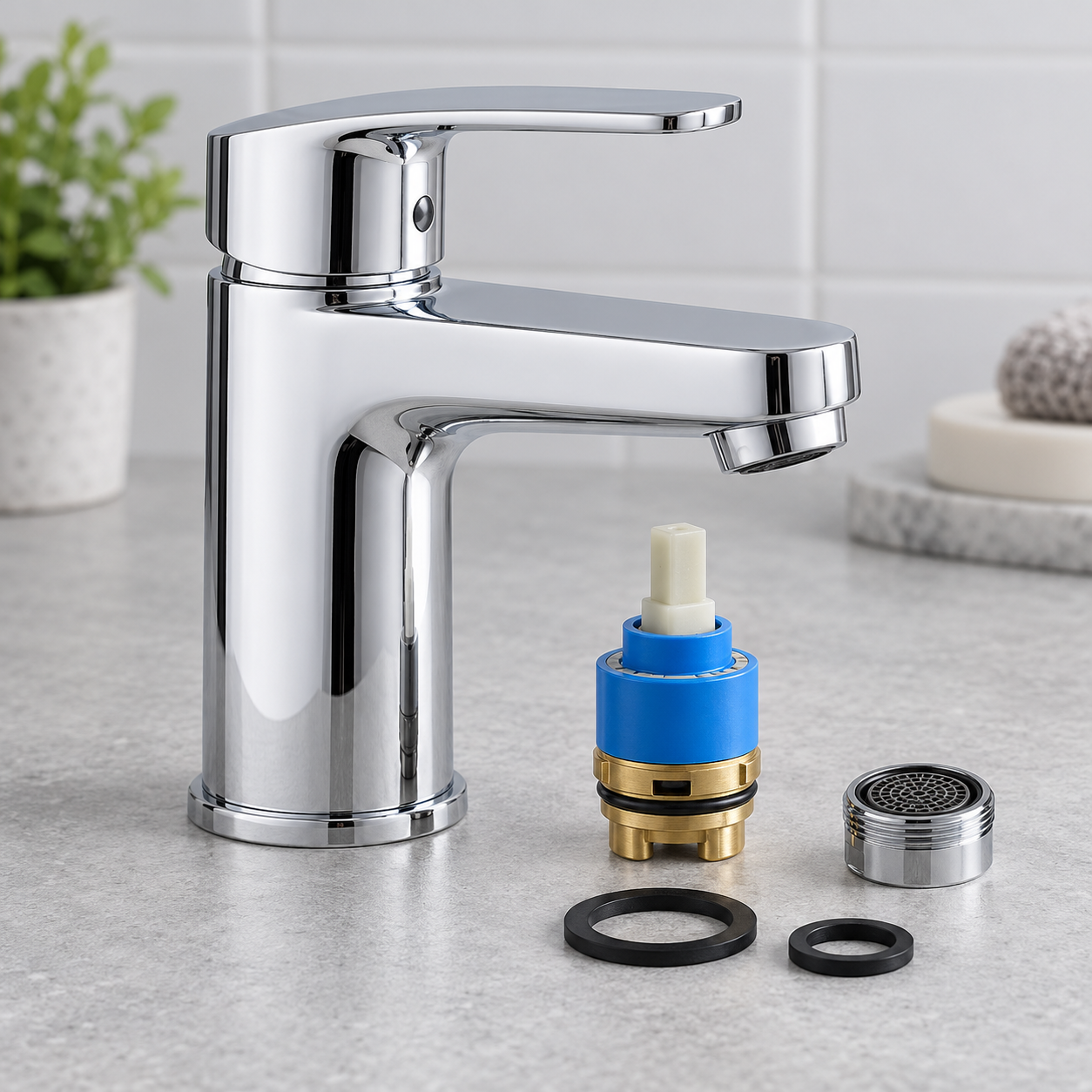

Compare bathroom fittings beyond unit price by checking replacement parts, product identification, service access and support after discontinuation. Use these questions to build a practical maintenance plan.
Repairable bathroom hardware gives project buyers a reason to look beyond the opening purchase price. A faucet with an identifiable replacement cartridge, accessible service points and a dependable parts supply can be easier to keep in use than a similar-looking fitting with no documented repair route. For hotels, distributors and property operators, that difference belongs in the procurement specification.
Public manufacturer service tools already show how parts identification and after-sales support can be made visible to buyers. The opportunity is to turn these features into questions that suppliers must answer before the product schedule is approved.
Why Repairable Bathroom Hardware Deserves a Buying Criterion
A bathroom fitting is purchased once but may need attention several times during its service life. The cost of a repair includes the replacement part, diagnosis, labor, access and downtime. Replacing the entire fitting can also involve removal, installation and disruption to nearby surfaces.
That does not mean every damaged product should be repaired. The practical question is whether an economical, documented repair is available when a serviceable component wears out. Ask suppliers which components can be replaced and which faults require a complete replacement. This makes quotations easier to compare and gives the operator a realistic maintenance plan.
Ask What Happens After a Model Is Discontinued
A warranty period and a spare-parts availability period answer different questions. The warranty defines the terms under which a claim may be covered; the parts commitment concerns whether a replacement can still be obtained. Neither statement alone tells the buyer how quickly a part will reach a particular site.
For example, hansgrohe’s spare-parts and repair FAQ states a 15-year availability commitment after product discontinuation. This is a specific manufacturer’s statement, not a general industry rule or an Anwell commitment. Use it as a reference for asking what each proposed supplier actually offers, including applicable terms and local delivery arrangements.
Request written answers about the availability period, the event that starts that period, ordering channels, minimum quantities and lead times. Also ask how the supplier communicates a discontinued model or a replacement part number to overseas buyers.
Make Product and Part Identification Traceable
Maintenance staff need to identify the installed fitting after the original carton has been discarded. Record the model number, finish code and any revision or date identifier supplied with the order. Keep those details in the handover schedule alongside room or location references.
The hansgrohe spare-parts search guide explains product-number identification and the use of exploded drawings and numbered parts lists. Such tools illustrate the information a buyer should request: a drawing that relates the assembled product to orderable service parts.
A phrase such as “standard cartridge” is too vague for repeat procurement. Confirm the exact part reference, its compatible models and whether a replacement changes the approved product configuration. Matching diameter alone should not be treated as proof of interchangeability.
Review the Repair Route Before Installation
Ask how the specified service parts are removed and replaced. Check which covers must be opened, what tools are required and whether the fitting needs to be detached from the basin or wall. Installation choices can make an otherwise serviceable product difficult to reach.
During sample review, have the installer examine the maintenance procedure using the intended countertop or wall arrangement. Confirm that routine access does not require an improvised opening or unnecessary disturbance of finishes. Record any model-specific instructions for isolation, replacement and recommissioning.
This review should cover the accessories as well as the faucet. A broken shower holder or missing mounting bracket can make a whole assembly inconvenient to use even when its main components remain sound.
Build a Spare-Parts Plan Around the Project
An initial spare-parts kit should reflect the installed models and the operator’s maintenance capacity. Agree the contents with the supplier rather than applying an arbitrary percentage to every component. Keep parts labeled, dry and linked to the model schedule.
For multi-property operators, fewer compatible part families may simplify stockholding, but any commonality needs verification. Private-label buyers should also agree who maintains the model-to-part records when packaging or catalogue numbers change.
Compare offers using both the product quotation and a representative service basket: key spare-part prices, shipping costs, lead times and expected access requirements. These are comparison inputs, not a promise of a particular lifetime saving.
Specifying repairable bathroom hardware is most useful when parts, documentation and supply arrangements remain connected to the installed product. Share your project duration, model schedule and after-sales requirements with Anwell Hardware when discussing bathroom hardware sourcing.