Email : info@anwell-hardware.com

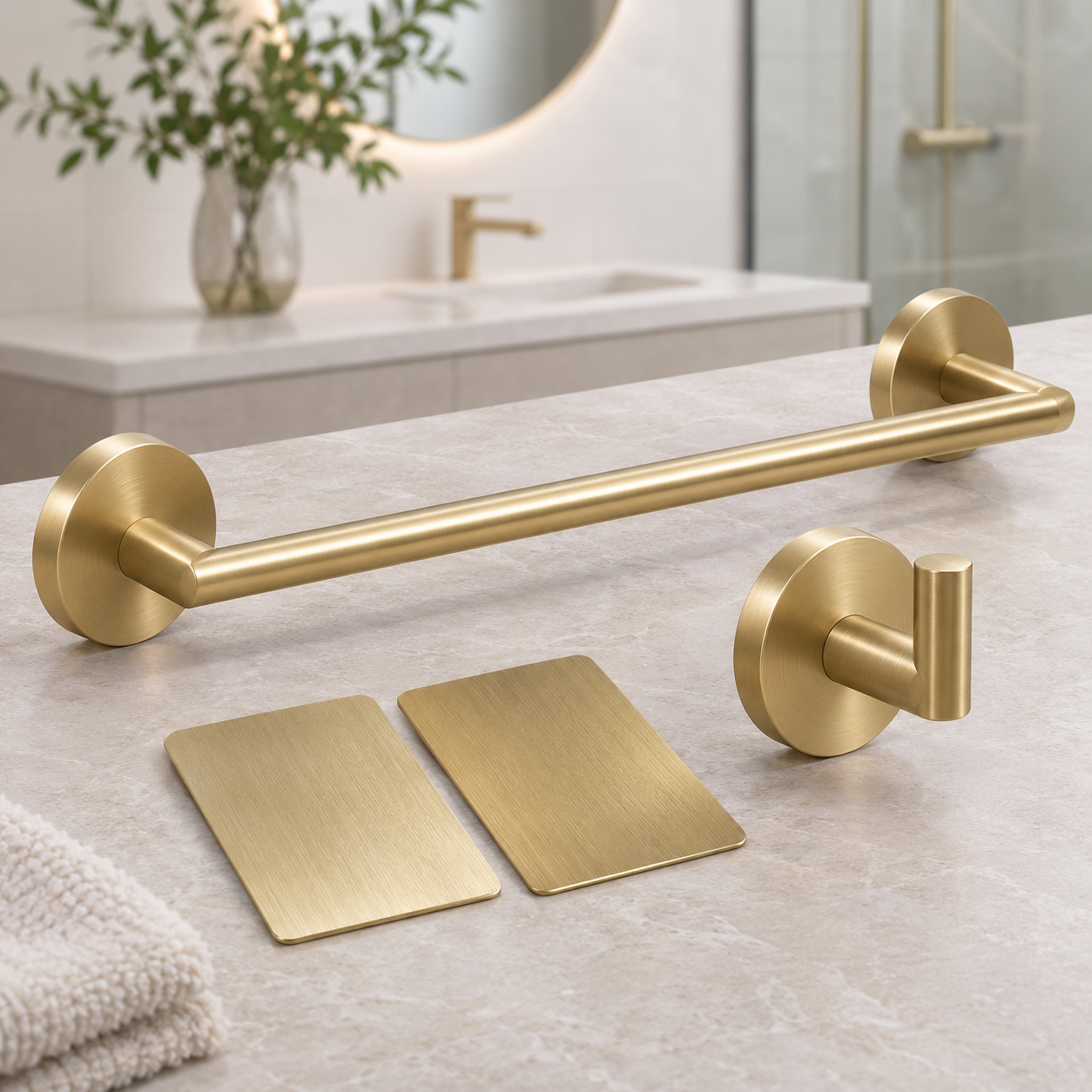

Before placing a bulk order, approve a physical sample for the brushed gold finish on the exact bathroom accessory and record how it will be compared. A finish name or screen image alone is not a reliable acceptance reference: lighting, viewing angle, surface curvature and brushing direction can change how a warm metallic surface appears.
Brushed gold finish approval starts with the right sample
Ask to review a representative finished item from the same product family and surface process planned for the order. A flat color chip can help compare tone, but it cannot show how directional grain behaves across a towel bar, robe hook or round mounting plate. For a coordinated set, review the key shapes together where practical.
Keep the evaluation repeatable. Compare the sample and any later production pieces under the same neutral lighting, against the same background, and from similar viewing angles. Do not approve one item under warm showroom lighting and judge another under cool warehouse lighting. Photographing the sample can help with records, but a photo should supplement—not replace—the physical reference.
Separate color, sheen and brushing direction
Record the visual attributes that matter to your customer: overall hue (for example, warmer or paler gold), gloss level, visible grain direction, grain uniformity, and whether edges or recessed details look noticeably different. This turns “make it match” into a review that two people can repeat.
Brushed gold finish consistency needs an agreed tolerance
Brushed gold finish needs a written sample reference
“Brushed gold” describes an appearance, not one universal color value. If color measurement is available and useful for the program, agree in advance on the instrument, measurement locations, color space, calculation method and acceptance limit. A numeric result without those details can create false confidence, especially on curved or highly reflective pieces.
ASTM D1729 describes visual appraisal of colors and color differences for diffusely illuminated opaque materials. ASTM D2244 covers calculations of color tolerances and differences from instrumentally measured color coordinates. These are useful references for agreeing on a review method; they are not, by themselves, a mandatory bathroom-hardware finish specification. Choose a practical acceptance limit with the supplier and project team, and correlate instrument readings with visual judgment.
Use one master reference and control revisions
Identify the approved sample with the item or finish code, date, reviewer and revision. Store it so it is protected from scratches, fingerprints and fading. If the finish, base material or process changes, request a new sample and approval rather than assuming the earlier reference still applies.
Check the whole accessory collection, not one piece
For small e-commerce assortments, wholesale cartons or multi-room projects, the buyer’s risk is often a mismatch between related pieces. Compare the towel bar, ring, hook and paper holder side by side. Inspect both broad faces and visible edges; compare grain direction, tone and sheen. A round escutcheon may reflect light differently from a long bar even when their finish is similar, so the comparison should focus on the agreed appearance rather than demanding identical brightness from every shape.
Also verify the product identity during sample approval. A useful sample record includes:
- Product or SKU, finish name, material description supplied for that item, and sample revision.
- Reference photos and a short written description of acceptable visual variation.
- Lighting and viewing conditions used for the approval.
- Which pieces in the set were reviewed, and whether packaging labels must identify the finish or variant.
- Who can approve a deviation and how rejected or reworked pieces will be handled.
Link finish approval to the order and incoming check
Put the approved reference and agreed criteria into the purchase specification or sample approval record. Before shipment release, inspect a representative selection from the finished order against that reference using the same viewing conditions. If a difference is disputed, pause the affected SKU, document the comparison, and agree whether it is acceptable before cartons are mixed or released. Do not invent a universal AQL or instrument threshold: sampling plans and limits should be defined for the order and risk.
This process helps importers and distributors reduce avoidable finish disputes while keeping the decision proportionate to order size. It cannot guarantee that every bathroom appears identical in every room; lighting, installation context and adjacent materials still influence perception.
Prepare a useful sample or quotation request
When requesting a sample or quote for the brushed gold finish on an accessory set, send the product references, required pieces and quantities, destination market, intended application, preferred finish reference or visual description, and any packaging or labeling requirements. Ask which exact sample will represent production and how changes will be approved. Anwell’s brushed-gold 304 stainless-steel accessory-set page was supplied by the buyer, but its live URL could not be verified during this review; confirm the product page and contact/RFQ destination before publishing links.
If you are comparing a specific set, review the 304 stainless-steel brushed-gold bathroom accessories set, then share the SKU list, required quantities, destination market, and approved finish reference with the sales team so the sample scope and quotation can be aligned before ordering.